The parachute suit that never opened.
A tailor. An experimental parachute suit. A test from the Eiffel Tower that should never have used a human subject.
The man at the edge
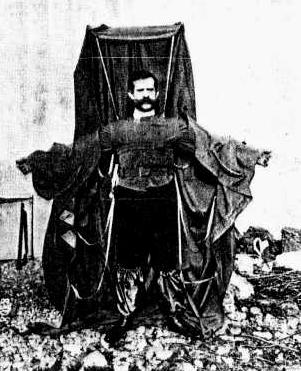
On 4 February 1912, a tailor named Franz Reichelt stood on the first platform of the Eiffel Tower wearing a parachute of his own design. Below him, a camera was running. It had already caught him on the ground showing off the outfit, spreading its fabric so people could see what he had brought. Now he had reached the part of the demonstration that the garment couldn’t do for him. He had to step off.
The suit looks unwieldy in the surviving film. That matters, because the whole point of the invention was convenience. Reichelt wanted a pilot to have a parachute already on his body when he needed it. There would be no need to reach for separate equipment in the middle of an emergency. In the years when powered flight was still new, it was a reasonable problem to spend your time on. The catch was that the outfit had to be practical to wear and still contain enough fabric to slow a falling person.
A tailor’s solution
Reichelt was Austrian-born and worked in Paris. He approached the problem with the tools of his trade. If you make clothes for a living, it makes sense to see a garment as something you can change until it does a job better. Here the fit was only the start. The material had to spread out, catch the air and stay open long enough to make a difference. It all had to happen in the space between leaving an aircraft and reaching the ground.
Reichelt used weighted dummies in his early experiments. Later accounts describe failures and say that when he tried a jump himself, he broke a leg. He put the failures down to the height of the tests. A parachute might need longer to open than he was giving it. The higher the starting point, the more time the fabric would have. If that explanation was right, the previous failures hadn’t settled the question. If it was wrong, a higher jump would simply make the landing worse.
Why the Eiffel Tower?
The first platform was more than fifty metres above the ground. For Reichelt, that put it in a different category from the lower drops he had tried before. For the people gathered to watch, it also made the test unusually easy to understand. They didn’t need to know much about aeronautics. The fabric would either open and slow the fall or it wouldn’t. A test with a dummy could have shown them which of those things happened while leaving Reichelt free to alter the design afterwards.
Instead, he went up wearing it. That is the turn in the story, and you can see the difference in the film. On the ground he has an audience and a garment to demonstrate. Up on the platform the audience can only watch. The suit is still gathered around him. There is a pause before he goes, long enough to make the jump feel less inevitable than the headline suggests. Then he steps out.
What the film kept
The material doesn’t open into the parachute he intended. The fall lasts seconds and Reichelt dies. Contemporary newspapers reported the jump, and the surviving newsreel preserves the demonstration itself. There is no need to guess what he was thinking in that pause. The camera gives us the outward part of it. We can see how long he stands there and how little time the suit has to do its job once he leaves the platform.
The bit that stays with me comes earlier in the footage. Reichelt is still on the ground, holding the fabric out for people to see. He looks like a tailor showing off something he has made, which is exactly what he is. The people around him can look at the suit, and he can explain how it ought to work. It is the last part of the demonstration where a failure would have meant going back to the workroom.
Sources & further reading
- British Film Institute — archive footage analysis ↗
- National Library of New Zealand — 1912 newspaper report ↗
- Atlas Obscura — background and earlier experiments ↗
Get every answer right to earn 50 points once per story. Sign in to save your points.